Clinical Pharmacy & Inventory: safe dispensing for every prescription, and stock without waste
The pharmacy is the last point where a medication error can be stopped before it reaches the patient. It is also a stock of considerable financial value. An expired drug on the shelf, an antibiotic dispensed without review, or a controlled drug that cannot be accounted for: each is a loss in both safety and money.
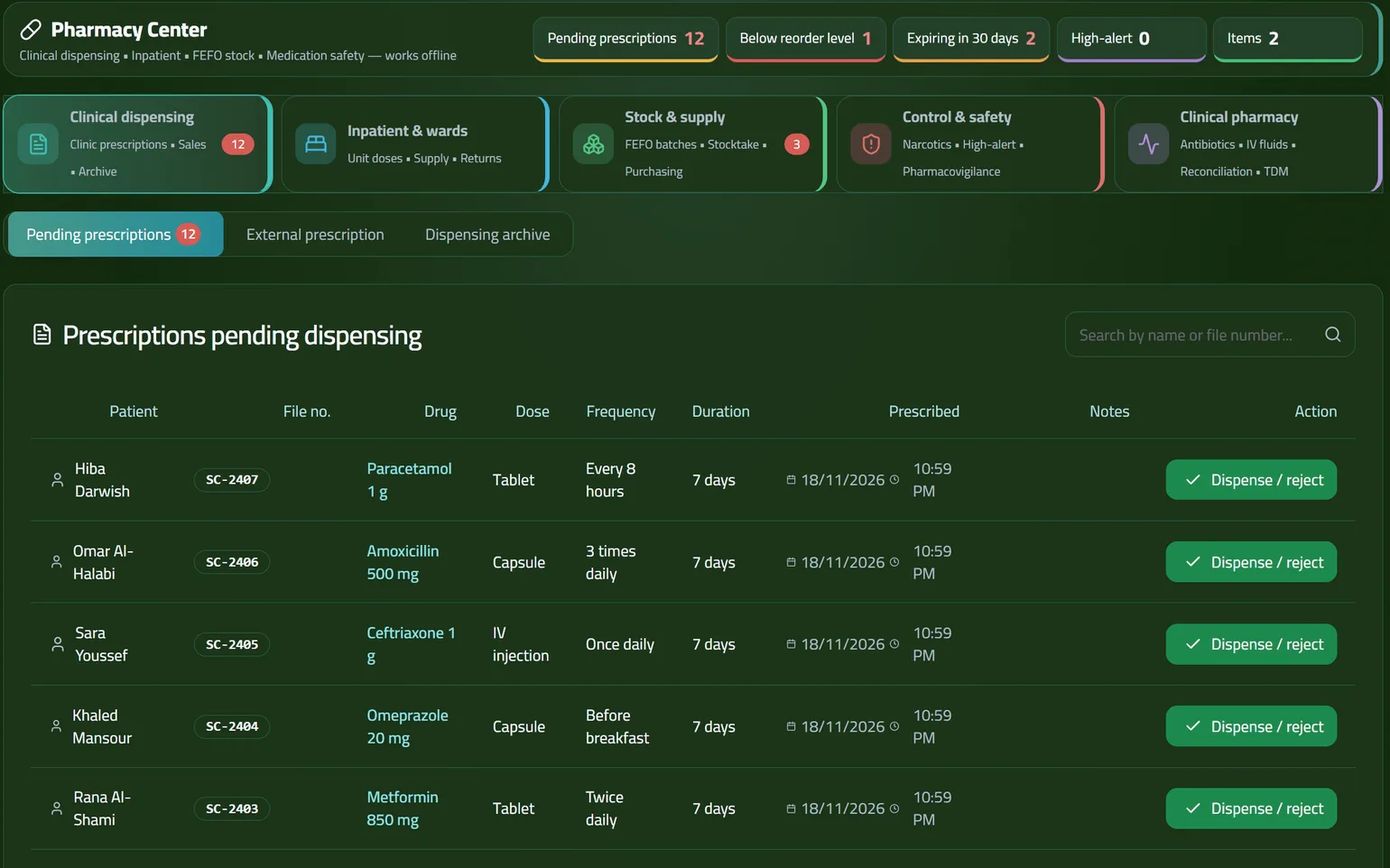
The ClinivaSys pharmacy organizes work into five stations covering dispensing, wards, inventory, control and clinical pharmacy. Every prescription is checked before dispensing, the earliest-expiring stock is dispensed first, and every medication dispensed is matched against every dose given. All of this relies on a built-in drug reference that works without any internet connection.
the physician writes the prescription, Clinical AI checks it, and it reaches the pharmacy instantly.
2
Review before dispensing
the system checks the patient's allergies and drug interactions, high-alert medications, look-alike and sound-alike drugs, and dosing by kidney function and the child's weight.
3
Dispensing from the right batch
the drug is dispensed from the earliest-expiring batch, deducted from stock at the moment of dispensing, and linked to the patient record and invoice.
4
Delivery to the ward
the medication reaches the inpatient as individual doses, and nursing records administration after scanning the patient's wristband.
5
Closing the loop
the system matches every medication dispensed against every dose given.
Features in detail
Five workstations
Station
What it covers
Clinical Dispensing
Clinic prescriptions, sales and archive
Inpatient & Wards
Unit doses, ward restocking and returns
Inventory & Supply
FEFO batches, stocktaking and purchasing
Control & Safety
Controlled drugs, high-alert medications and pharmacovigilance
Clinical Pharmacy
Antimicrobials, IV preparations, reconciliation and therapeutic drug monitoring (TDM)
Safe, fast dispensing
Built-in drug reference that works offline, searchable by brand name, active ingredient or drug class.
Interaction and allergy checks before dispensing, not after.
Dispensing of external prescriptions alongside prescriptions from the hospital's own physicians.
Direct sales to visitors with an official, numbered invoice that carries the hospital's identity.
Stock without waste
Inventory managed by batch, lot number and expiry date for every drug.
FEFO (first expired, first out): the earliest-expiring stock is dispensed first.
Low-stock and safe reorder-level alerts, plus alerts for drugs nearing expiry before they turn into a loss.
Reorder suggestions based on consumption rate, with stocktaking and purchasing from the same station.
Returns and expired drugs removed from stock with a documented record.
Dispensing and stock movement reports that show the actual consumption of each department.
Control and safety
Controlled drugs handled in a dedicated control station.
High-alert medications flagged and kept under additional control.
Pharmacovigilance: reporting of adverse drug reactions.
Cold chain: recording and monitoring of medication refrigerator temperatures.
Tracking of crash cart seals.
Witnessed, documented destruction of drugs taken out of service.
Advanced clinical pharmacy
Antimicrobial stewardship: a restricted antibiotic cannot be dispensed without approval, and its review is mandatory after 72 hours.
Preparation of IV solutions within the pharmacy.
Medication reconciliation at admission, so no home medication is missed or duplicated.
Therapeutic drug monitoring (TDM) of drug levels in the blood.
A closed loop with the wards and nursing
Unit doses for inpatients, plus ward restocking and returns, from the Inpatient & Wards station.
Every medication dispensed is matched against every dose recorded in the medication administration record (MAR), so any gap between dispensing and administration shows up.
Why doesn't dispensing stop when the internet goes down?
Because the drug reference is built into the software, and the pre-dispensing checks, stock deduction and linking of each drug to the invoice all run on the hospital's server and internal network. The pharmacy does not wait for an external service to flag a drug interaction or report a batch balance. During an outage, dispensing continues at the same speed and with the same checks.
What each team gains
Pharmacists
an automatic check before every dispense, a drug reference that needs no internet, and automatic enforcement of the restricted antibiotic policy.
Physicians
prescriptions reviewed twice, and patients admitted with their home medications reconciled.
Nursing
individual doses ready to administer, and organized ward restocking.
Management
less waste from expired drugs, and documented control over controlled drugs and their destruction.
Frequently asked questions
Questions about this module
If you don't find your answer, message us directly.
We use only the cookies needed to run this website. Visitor analytics (Google Analytics) run only if you agree, and you can change your choice at any time.