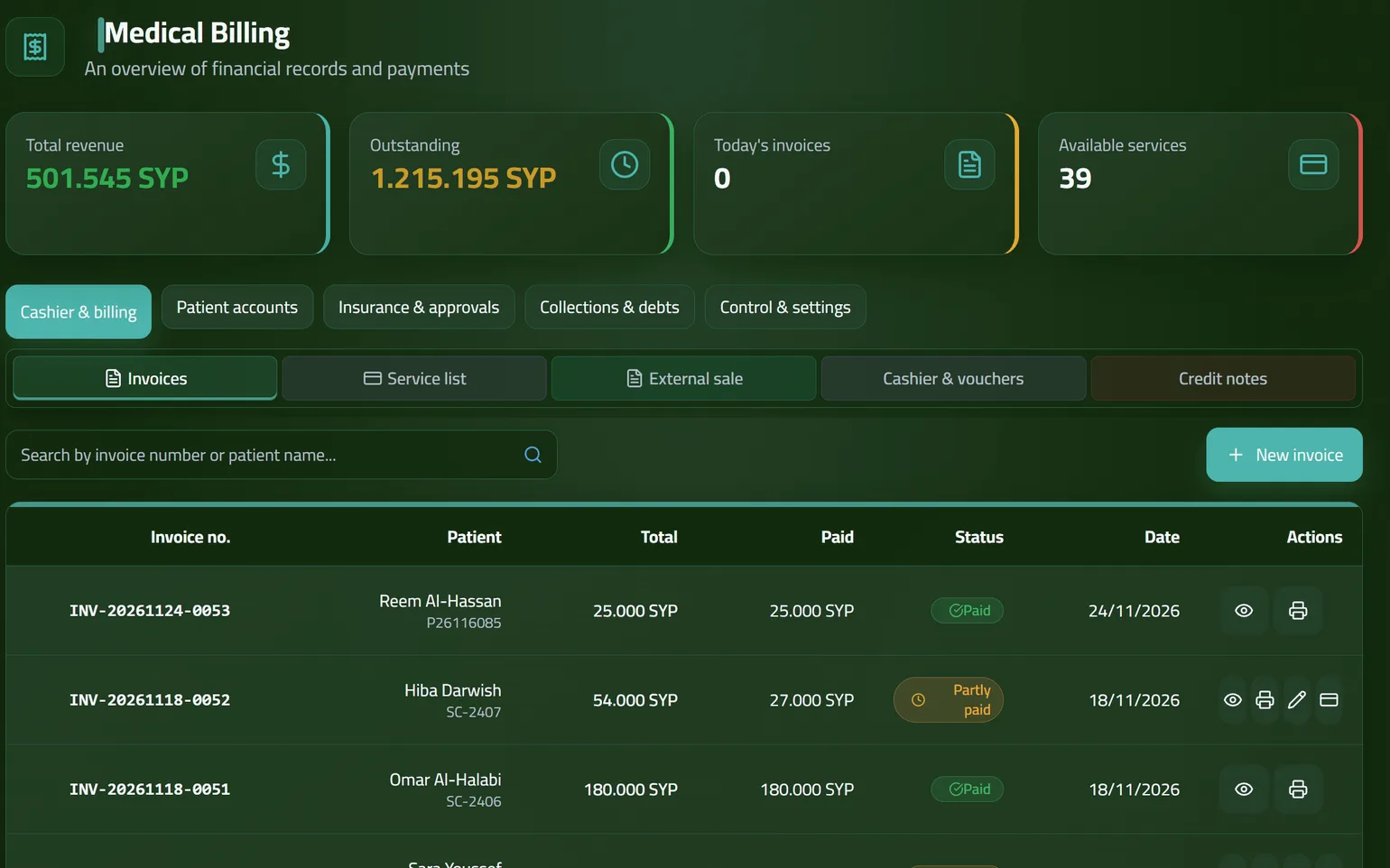
Billing & Finance: every service on the invoice, every amount under control
In many hospitals, revenue leaks away in the details: a lab test performed but never billed, an inpatient discharged before the account was settled, a cash drawer closed with a figure that doesn't match the cash, an insurance claim rejected for an error that could have been caught before it was sent.
The ClinivaSys billing module brings the entire revenue cycle together in 21 sections, organized into five groups: cashier and billing, patient accounts, insurance and approvals, collections and debt, and controls and settings. Every service a doctor orders or a department performs is added to the patient's invoice automatically, and amounts are shown in the local currency the facility uses. Because the module runs on the hospital's own server, the cash desk keeps working even when the internet goes down.
every consultation, lab test, imaging exam or medication is added to the patient's open invoice automatically, so no item is forgotten or entered twice.
2
Insurance is calculated instantly
the insurer's share and the patient's share are calculated for each line item.
3
Payment
the cashier accepts cash, card or several methods on the same invoice; the system calculates the remaining amount and issues a numbered receipt.
4
Accounting entry
journal entries are derived directly from invoices and receipts.
5
Shift closing
the cashier counts the cash by denomination without seeing the expected balance, so any discrepancy shows up.
Features in detail
Cash desk and invoicing
Numbered invoices on a single official template, with the hospital's letterhead, logo and license details.
A smart invoice that adds new services to the patient's pending invoice instead of scattering them across separate invoices.
Split payment across several methods, with change calculated automatically, and a numbered receipt for every payment, without exception.
Service packages, discounts and external sales.
Management of financial shifts and vouchers, and cash handover between shifts.
Patient accounts and inpatient stays
A full statement of account for every patient, with deposits, advances and outstanding balances.
Inpatient days are calculated for admitted patients and added to the invoice automatically.
Credit notes within the patient's account.
Financial clearance: an inpatient is not discharged before financial clearance, and only then is the discharge permit issued.
Insurance and approvals
Management of insurance companies, with the insurer's share and the patient's share calculated automatically for each line item.
Financial approvals for admission: insurance, an advance payment, or deferred payment added to the invoice.
Insurance claim review before submission, to catch errors before they reach the insurer.
Collections and debt
Installment plans, with due and overdue installments tracked for each patient.
A credit limit to control how much debt is allowed.
Financial WhatsApp notifications to patients with ready-made messages, with no messaging fees.
Physician fees and donation funds
Physician fees calculated from the services each doctor provided and carried over to payroll.
Donation funds to support patients.
Controls and accounting
Blind cash closing by counting denominations, without showing the expected balance in advance.
A chart of accounts and a journal, both derived from invoices and receipts.
CFO indicators to monitor the hospital's financial performance.
Sensitive operations require verification with the administrator's password.
Every receipt, discount and change is recorded under the name of the person who made it.
From admission to discharge: the inpatient account
An inpatient account runs for days and includes many items, so the system follows it financially at every stage:
At admission: financial approval before a bed is assigned, through insurance, an advance payment, or deferred payment added to the invoice.
During the stay: inpatient days and every service and medication are added to the same invoice automatically, and the statement of account stays up to date.
At discharge: a final invoice is generated automatically, followed by financial clearance and then the discharge permit.
No patient leaves with an unsettled item on their account, and no one waits at the billing desk while separate invoices are pulled together.
What each team gains
Cashiers
a ready invoice with no manual entry, and split payments with the remaining amount calculated automatically.
Accounting
journal entries derived from actual transactions, and a ready-made chart of accounts.
CFO
financial indicators, blind closing that exposes discrepancies, and a credit limit that keeps debt in check.
Doctors
fees calculated from the services they actually provided and carried over to payroll.
Patients
one clear invoice, installments when needed, and notifications via WhatsApp.
Frequently asked questions
Questions about this module
If you don't find your answer, message us directly.
Yes. Every service a doctor orders or a department performs is added to the patient's open invoice, with no action needed from finance staff.
What is blind cash closing?
The cashier counts the cash by denomination without seeing the expected amount, so any difference between the count and what the system recorded shows up.
Does the system support health insurance?
Yes. It calculates the insurer's share and the patient's share for each line item, manages financial approvals and reviews claims before they are submitted.
Which currency does billing use?
The local currency the facility uses. Invoices, receipts and statements of account all appear in that currency.
Related modules
They work together in one system, and data moves between them automatically.
We use only the cookies needed to run this website. Visitor analytics (Google Analytics) run only if you agree, and you can change your choice at any time.